Good pool lighting does more than let you see the water after sunset. It decides whether the backyard feels calm or harsh at night, whether people can find the steps without thinking about it, and whether the plantings you invested in disappear the minute the sun goes down. On Long Island, summer evenings are prime pool time for a lot of families, so the lighting plan deserves real thought.
We have touched on lighting in our posts on pool design ideas for a Long Island backyard and making an inground pool feel private. This post gets more specific. Below are the pool lighting ideas we talk through with homeowners when inground pool lighting, patio lighting, and pool landscape lighting are planned together as one backyard.
Think in Layers, Not Fixtures
The backyards that look best at night usually have several quiet layers of light instead of a few bright ones. Each layer has a job:
- The water: in-pool lights that give the pool an even glow.
- The way in and out: steps, benches, and entry points.
- Where people walk: paths, patio steps, and the route to the house or the gate.
- What you look at: trees, plantings, stone walls, and water features.
When each layer only does its own job, you need less light overall and the yard looks softer. DarkSky International, which published its outdoor lighting principles jointly with the Illuminating Engineering Society, puts it simply: light where you need it, when you need it, in the amount needed, and no more. That is a good rule for a backyard, too.
In-Pool LED Lights: Placement, Count and Color
For underwater lights, LED is hard to beat. The U.S. Department of Energy says LEDs use up to 90% less energy and last up to 25 times longer than incandescent bulbs. Our post on what pool features to install during construction explains why the in-pool lights belong in the original build. Here is what to talk about when you get to that part of the plan.
Aim the lights away from where you sit. The most common mistake is putting lights where you end up looking straight into them. A good rule is to position lights so the beam points away from the house and its main viewing spots, with the goal of hiding the light source so the pool seems to glow on its own. If the pool runs parallel to the house, that usually means lights on the wall closest to the house, shining out across the water. If the pool runs perpendicular to the house, the lights should face away from the part of the yard you use most, like the patio or lawn.
More, smaller lights usually beat a few big ones. It is generally better to install more lower wattage lights than fewer high wattage lights, because the total wattage ends up similar and the glow is more even, without dark spots or hot spots. Darker finishes need more light. Freeform pools, pools with sun shelves, and pools with several sections often need more. The size and shape of the pool, where the house sits, and the features in the water all change the count, so it should be worked out on the pool plan instead of guessed at.
Your liner color matters. This one is easy to overlook. Lighter pool finishes reflect light and darker finishes absorb it. White lights also tend to look brighter than color settings, and in a dark finish pool some colors can look dim. If you are leaning toward a dark vinyl liner pattern, bring it up while the lights are being planned.
Color or white. Many LED pool lights can switch between white, solid colors, and preset color shows. Color is fun for parties and for kids. On an ordinary weeknight, a soft white often looks calmer from the house, so think about how you will use the lights most nights, not only on the Fourth of July. If you want several color lights to change together, they should all be on the same on/off circuit, which is one more reason to settle the lighting plan before the electrical work goes in.
Step and Bench Lighting
Steps and benches are where people move in and out of the water, so this is where light earns its keep. Good lighting helps prevent accidents, and pool steps, entrances, and exits should always be well lit.
A few placement details make a big difference:
- Benches: if a bench runs along the wall where lights need to go, the guide recommends setting the light several inches below the edge of the bench so the bench does not cast a shadow.
- Spas: lights go below the bench or in the footwell, so people are not leaning back against the light and blocking it.
- Sun shelves: lights in a shallow ledge sit close to the surface, so hot spots can be hard to avoid. That makes aiming them away from the house even more important.
If you are still deciding on steps, benches, or a tanning ledge, our post on pool steps, benches, and tanning ledges covers the layout side. Decide the lighting at the same time, since the light locations follow those features.
Patio and Path Lighting
Once you step out of the pool, the light has to carry you across the patio, down any steps, and back to the house or the gate. Path lights guide people through the yard and mark walkways, steps, and the spots where one area turns into another.
The goal is to light the ground, not people’s eyes. Low fixtures that point down, step lights set into risers or seat walls, and shielded fixtures all keep the light on the surface you are walking on. DarkSky recommends shielding and careful aiming so light points downward and does not spill beyond where it is needed, and keeping light no brighter than necessary. Its home lighting guide also warns that too much light can cause glare, which is the last thing you want on wet stone at night.
Patio lighting works best when it is planned with the patio itself. Seat walls, steps, and changes in level are natural spots for built-in lights, and they are much easier to wire before the stone goes down. If a new patio is part of your project, see our patios and outdoor living spaces page, and read our post on pool patio mistakes before the layout is final.
Uplighting Trees and Plantings
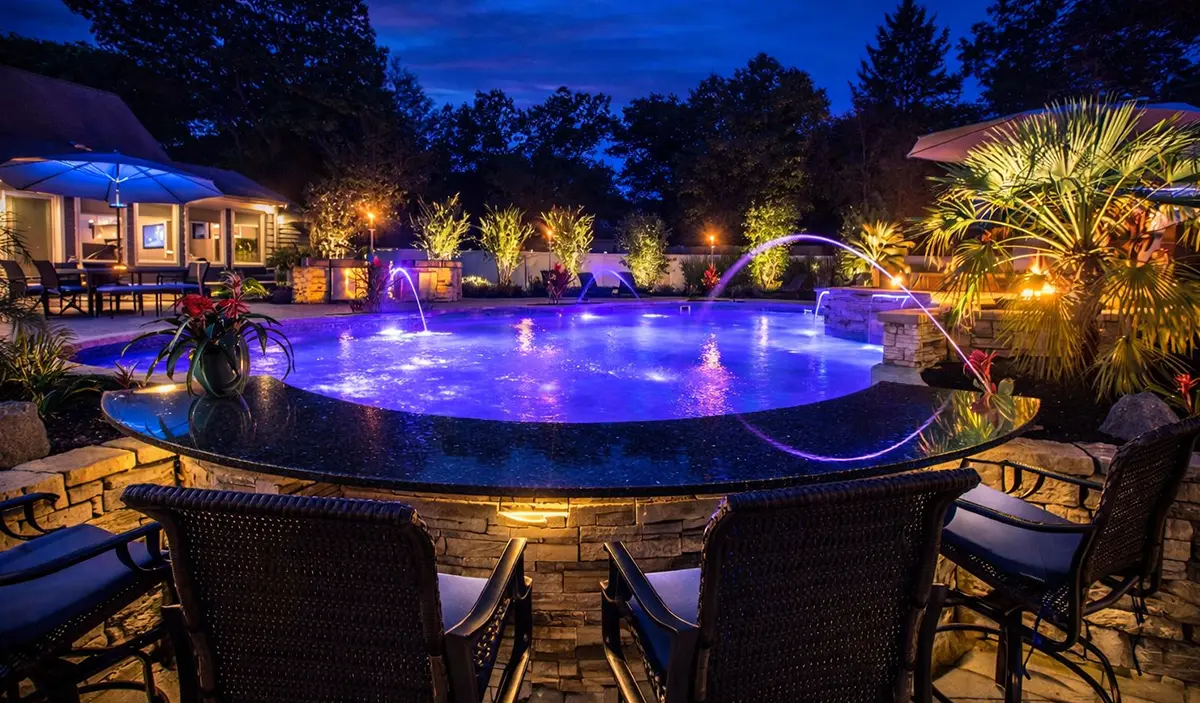
This is where pool landscape lighting turns a dark yard into a view. Uplighting puts a fixture at ground level and aims it up at a tree, shrub, or wall to show off the trunk and canopy. Moonlighting works the other way: a fixture mounted high in a large tree shines down through the branches and casts soft, dappled shadows on the ground below.
Pick a few things worth seeing from the patio and the house, such as a specimen tree, a row of evergreens along the property line, a stone wall, or a waterfall, and light those. You do not need to light every plant. Two more details matter around a pool:
- Warm light: DarkSky recommends warmer-color lights where possible. Its home lighting guide treats 3000 Kelvin or less as warm and points to good home options at 2700 Kelvin or less. Check the Kelvin rating before you buy, because it is printed on most bulbs and fixture specs.
- Neighbors: Long Island lots can sit close together. DarkSky’s home guide says to be especially mindful of light spilling up into the sky or onto other people’s property. Aim uplights carefully, and use shielded fixtures anywhere a neighbor’s window lines up with the beam.
For planting ideas that work around the water, see our post on poolside landscaping ideas for Long Island inground pools. Our landscape design service plans plantings, stonework, grading, and lighting together, so the fixtures land where the plants will be, not where they used to be.
Lighting for Safety Around the Pool at Night
When it is done well, beautiful lighting and safe lighting are mostly the same thing. A few priorities:
- Light the steps, entries, and exits of the pool so swimmers can find them easily.
- Light the pool evenly. Dark spots and shadows make it harder to see into the water.
- Light the path from the house to the pool, and any step or change in level on the patio.
- Light the route to the pool gate, so nobody is fumbling with a latch in the dark.
- Keep glare off the water and out of people’s eyes, since glare can hide the things you need to see.
Lighting is one piece of pool safety. It does not replace the fencing and gates your property needs or an adult watching whenever people are in the water.
Plan the Wiring Before the Patio Goes In
Conduit is easiest to run while the ground is open, and that applies to lighting as much as anything. Here is how to plan for it.
Put every light on the plan. Before excavation, mark each in-pool light, step light, patio light, and landscape fixture you might want, including the ones you plan to add in a few years. Each one needs a path back to power, and many of those paths cross under the patio.
Run sleeves to the planting beds. Empty conduit under the patio, ending in the beds where uplights and path lights will go, lets you add landscape lighting later without cutting through finished stone.
Decide where the transformer goes. Most residential landscape lighting runs on low-voltage 12-volt systems powered by a transformer. Transformers also come with their own installation instructions, which often call for keeping them well away from the pool, so follow the instructions for the unit you choose. Pick the spot early so it fits the design instead of ending up wherever there happens to be an outlet.
Leave the electrical work to the pros. Pool wiring has its own article in the National Electrical Code, Article 680, and its central concern is keeping people and electricity separated. Underwater lights, junction boxes, bonding, and ground-fault protection are not do-it-yourself work. Our team handles the lighting and electrical work as part of the build, and the work is inspected wherever your town requires it.
Adding landscape lights in planting beds later is usually manageable. Adding in-pool lights or anything under a finished patio is a different story, so decide those early. When it comes to controls, timers and app control can bring the lights on at dusk and shut them off when everyone heads inside; our post on pool automation and smart pool controls covers how that works.
Planning Pool and Backyard Lighting on Long Island
The best time to plan backyard pool lighting is while the pool, patio, and landscape are still on paper. Specht-Tacular Pools is a family-owned design-build company in Center Moriches that has served Nassau and Suffolk County for 27 years, and we design pools, patios, and landscapes to work as one backyard. Start with our pool design and construction services, or contact us at 631-696-3900 to talk through lighting for your yard.
Frequently Asked Questions
Often, yes. LED pool lights are made to fit existing pool light niches, so many older lights can be replaced without changing the pool wall. The right replacement depends on the existing fixture, its niche, and whether it runs on 120-volt or 12-volt power, since LED pool lights are sold in both. If you want the new lights to work with an automation system or change colors together, check compatibility before you buy. Our team can handle the swap for you.
It comes down to the look you like. Warm white reads softer and closer to an old incandescent bulb, while cool white looks crisper and bluer. DarkSky describes 2700 to 3000 Kelvin as warm white, similar to standard incandescent bulbs, and 4000 Kelvin and higher as cool white or blue. Some LED pool lights come in both warm and cool white versions. If your landscape lights will be warm, look at the pool and landscape lights together at night before deciding, so the yard does not look mismatched.
Big enough to carry every fixture on it, with room to grow. The total load of all the fixtures on a system should stay within the transformer's rating. A common practice is to leave extra capacity so fixtures can be added later. Voltage drops over long wire runs, so larger properties may need more than one transformer, along with the right wire size and layout. Our team sizes the system for your yard.
Usually not. Most backyard lights can go off on a timer, and lights you want available later, like a path or gate light, can run on a motion sensor. DarkSky's home lighting guide says outdoor lights should be connected to a switch, timer, or motion sensor, suggests setting motion sensors to 5 minutes or less, and strongly discourages dusk-to-dawn sensors because they keep lights on when nobody needs them. Shutting lights off at a set hour also saves energy and is easier on the neighbors.
Good lighting helps everyone see the water, the steps, and the edges of the pool after dark. It works best as one layer of safety alongside fencing, covers, and adult supervision. In-pool lights show the depth and the floor of the pool, step and bench lights mark where to get in and out, and path lights guide people across the patio. A light by the gate or along the walkway can run on a motion sensor so it is there when someone needs it. Plan lighting while the pool and patio are still in design so every key spot is covered.
Automation lets you run pool lights, pumps, and other equipment on schedules or from an app. That means less time at the equipment pad and more consistent care. Lights can turn on at dusk and off when everyone heads inside, and color-changing LED lights can be set to shift together. The same systems can schedule filtration and other routine tasks so the pool stays on a steady routine. Our post on pool automation and smart pool controls covers how it works.
The best landscapes frame the pool, match the style of the home, and stay easy to care for. Lighting brings that landscape into the evening. Uplit trees and plantings add depth, path lights along a paver patio mark the way, and stonework can be lit to show texture at night. Designing the pool, patio, landscape, and lighting together keeps the whole backyard working as one space. See our poolside landscaping ideas and landscape design services.