A backyard with mature trees can be one of the nicest settings for an inground pool. The trees may already provide privacy, shade, and a finished landscape that would take years to recreate. That does not mean every tree should stay.
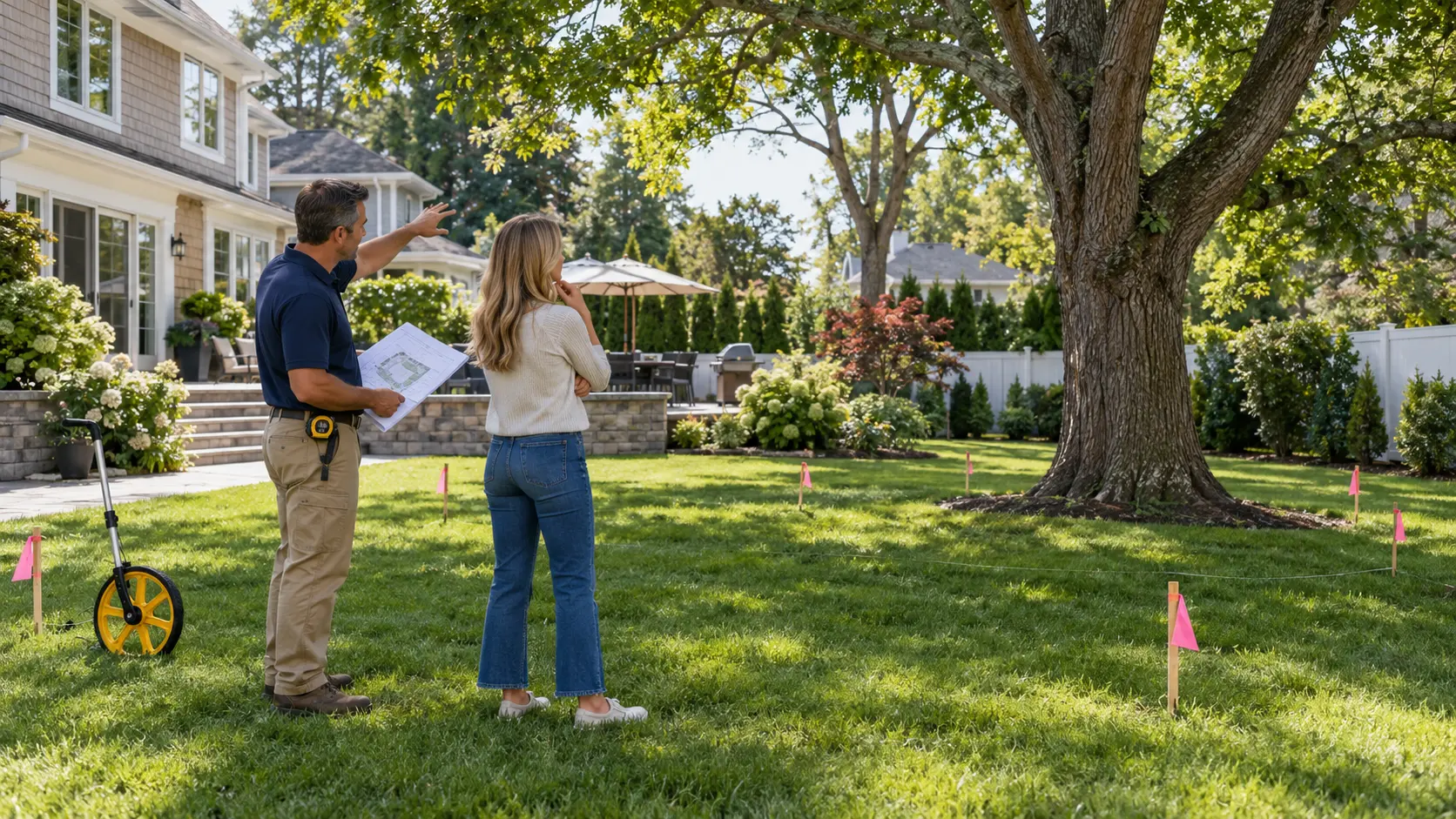
When a pool is being planned, existing trees need to be looked at individually. Some may be nowhere near the construction area. Others may sit directly where the pool, patio, plumbing, or construction equipment needs to go. A tree that appears far enough away above ground may also have roots extending through an area that needs to be excavated. Removing trees for a pool should not be an automatic first step. It should be part of the overall site-planning process.
Do Trees Have to Be Removed Before Pool Construction?
Not necessarily. If a tree is healthy, well positioned, and far enough from the construction work, there may be no reason to remove it. In some backyards, mature trees are an asset worth designing around.
Removal becomes more likely when a tree:
- Sits within the proposed pool footprint
- Interferes with the surrounding patio or hardscape
- Blocks the construction access route
- Has major roots running through an area that must be excavated
- Would be severely damaged by the excavation required for the project
- Is already in poor condition and could become a concern near the finished pool area
This is one reason pool placement should not be decided by looking only at an open section of lawn. The entire property has to be considered, including what is growing around it.
How Close Can an Inground Pool Be to a Mature Tree?
There is no single distance that works for every tree and every pool. A small ornamental tree and a large mature oak do not have the same root system, canopy, or long-term space requirements. Two trees of similar size may also respond differently when roots are disturbed.
The location of the pool is only part of the equation. The surrounding patio, excavation area, plumbing runs, drainage work, and construction route all require space too. For that reason, measuring from the tree trunk to the water’s edge does not tell the whole story.
A tree that appears to be comfortably outside the pool footprint could still be close to the area where excavation or patio preparation will occur. The goal is to leave enough separation for the pool project without causing unnecessary damage to a tree the homeowner intends to keep.
Tree Roots Can Extend Farther Than Homeowners Expect
One common assumption is that most of a tree’s roots are directly beneath the trunk and canopy. Mature root systems can extend well beyond the area that is obvious from looking at the tree above ground. That matters when an excavator starts removing soil for a pool.
Finding smaller roots while digging is not unusual. The greater concern is encountering substantial roots close to a mature tree. Cutting significant structural roots can affect the tree’s health and, in some situations, its stability.
This is why the decision about keeping or removing a large tree should be made before excavation begins whenever possible. It is much easier to adjust the design during planning than to discover halfway through excavation that preserving a particular tree has become difficult.
Can Tree Roots Interfere With Pool Construction?
Yes, but not always in the way homeowners expect. The concern is not simply that a root somewhere in the yard will eventually “attack” the pool. During construction, the more immediate issue is whether existing roots occupy the space that needs to be excavated or prepared. Large roots can complicate excavation. Cutting them can also damage the tree that is staying behind.
Roots may need to be considered when planning:
- The pool excavation
- Patio and hardscape areas
- Underground plumbing
- Electrical runs
- Drainage improvements
- Retaining walls or other structural work
This is another reason the whole pool environment should be designed together rather than treating the pool itself as the only construction area.
Sometimes Moving the Pool Is Better Than Removing the Tree
A tree does not always have to lose the argument. If a homeowner has a large, healthy tree that provides substantial privacy or has been part of the property for decades, shifting the pool may be worth considering.
Even a modest change in the pool’s position or orientation can sometimes create more room between excavation and the root area. A different pool size or shape may also work better with the existing landscape.
There are limits, of course. Moving the pool still has to work with the house, property lines, setbacks, utilities, septic components where applicable, drainage, construction access, and the amount of patio space the homeowner wants. The important point is that tree removal should not be decided in isolation. It is one of several factors that influence the final layout.
Construction Access Can Determine Whether a Tree Stays
The finished pool location is not the only place that needs room. Excavation equipment has to reach the backyard. Soil has to come out. Pool materials have to come in. Crews need enough space to perform the work. On many Long Island properties, access is along one side of the house. A mature tree located in that narrow construction route can create a very different problem from a tree at the far end of the backyard.
In some situations, the pool can be built without disturbing it. In others, the available access may be too restricted. This should be evaluated before the project begins, particularly on wooded properties or yards where fences, sheds, landscaping, air-conditioning equipment, and neighboring property lines already limit the available route.
Keeping a Tree Means Protecting More Than the Trunk
If a tree is going to remain, avoiding contact with its trunk is not enough. Pool construction involves heavy machinery, repeated equipment traffic, excavated soil, materials, and significant activity in a relatively concentrated portion of the yard. A tree’s root area can be affected even when nobody touches the trunk itself.
The plan should therefore consider how close construction activity will come to trees that are supposed to stay. This is especially important when preserving a large mature tree is one of the homeowner’s priorities. It makes little sense to redesign a pool around a tree and then severely damage that tree during construction.
Consider the Tree’s Condition Before Designing Around It
There is also a practical question that can easily be overlooked: Is the tree worth designing around? A healthy mature tree may be a valuable part of the backyard. A declining tree with major dead limbs, structural problems, or other significant concerns is a different situation. Before making major compromises to the pool layout in order to preserve a questionable tree, it can make sense to have the tree evaluated.
Removing a problematic tree before pool construction can be much simpler than removing it several years later when a pool, patio, fencing, landscaping, and outdoor furniture occupy the surrounding area.
Don’t Clear the Yard Before the Pool Is Designed
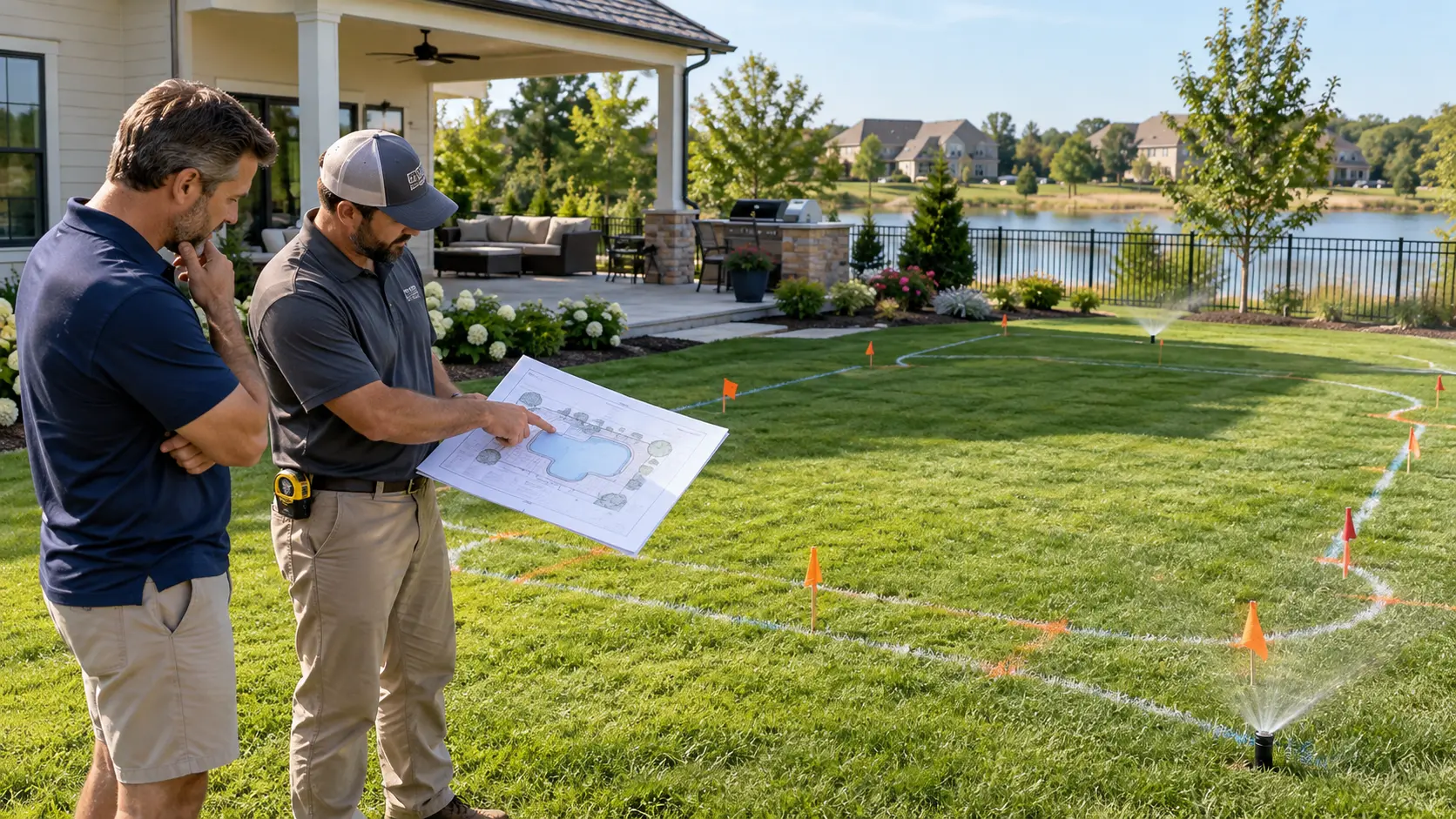
Homeowners sometimes assume they should remove trees and clear the backyard before calling a pool builder. That can eliminate options unnecessarily. A tree that looks like it is in the way may work perfectly well with a different pool orientation. Another tree that appears safely off to the side may turn out to interfere with access or construction.
It is usually more useful to evaluate the property first and decide what needs to stay or go once there is a clearer idea of where the pool should be located. This also gives the homeowner an opportunity to decide which parts of the existing backyard are important to preserve.
Plan for the Pool, Patio and Finished Backyard Together
A pool project extends beyond the water. The patio needs enough room for walking, seating and furniture. The yard still needs to function around it. Privacy, fencing, drainage, landscaping and access all have to work with the final design. Trees can influence every one of those decisions.
That is why a wooded or heavily landscaped backyard does not necessarily need to be cleared to make room for a pool. It needs to be evaluated carefully. Some trees may remain exactly where they are. Some may influence the shape or placement of the pool. Others may need to be removed because keeping them would compromise either the construction project or the tree itself.
For Long Island homeowners with mature landscaping, these decisions are best made before the final pool layout is locked in. A thoughtful plan can make room for a new inground pool without giving up more of the existing backyard than necessary.
Frequently Asked Questions
Not always. If the stump or major root mass is within an area that needs to be excavated or structurally prepared, additional removal may be necessary. Stump grinding primarily removes the visible stump and portions immediately below grade. It does not necessarily remove the entire underground root system. If the former tree location overlaps the pool excavation, patio base, retaining work, or another part of the project, the site may need additional excavation and preparation. The pool builder should know where recently removed trees were located so those areas can be evaluated as part of construction.
They can. Tree roots do not stop at a property line, so roots from a neighboring mature tree may extend into the area where pool construction is planned. This can require extra care because substantially cutting roots could affect a tree that is not on your property. If a large neighboring tree is close to the proposed excavation, it is worth identifying the issue early. Depending on the circumstances, the pool location may be adjusted or an arborist may be consulted before significant roots are disturbed. Questions involving ownership, responsibility, or permitted tree work should also be addressed before construction rather than after roots are uncovered.
Yes. Heavy equipment and repeated traffic can compact soil around a tree and affect the root environment even when the trunk and visible roots are untouched. Trees absorb water and nutrients through roots spread throughout the surrounding soil. Construction equipment, material storage, and repeated traffic can change or compact that soil. If an important mature tree will remain close to the work area, protecting the surrounding root zone can be just as important as avoiding direct excavation beside the trunk.
It can be worthwhile when preserving the tree would significantly affect the pool design or when there are questions about the tree's condition. An arborist can evaluate the health, structure, species, approximate root area, and potential sensitivity of the tree. This can provide useful information when a homeowner is deciding whether to shift a pool, protect a particular tree, or remove it before construction. An evaluation is especially useful when the tree is large, valuable to the landscape, unusually close to the proposed work, or showing signs of decline.
In most cases, removal is simpler before the pool, patio, fence, and finished landscaping restrict access to the tree. That does not mean every tree near a proposed pool should be removed as a precaution. A healthy tree may remain part of the backyard for many years. But if a tree has already been identified as declining, unstable, or likely to require removal soon, its future should be considered during pool planning. Removing a large tree after the backyard is finished can require more careful access and additional protection for the pool, patio, fencing, and surrounding landscaping.